Africa’s Top 10 – October 2025
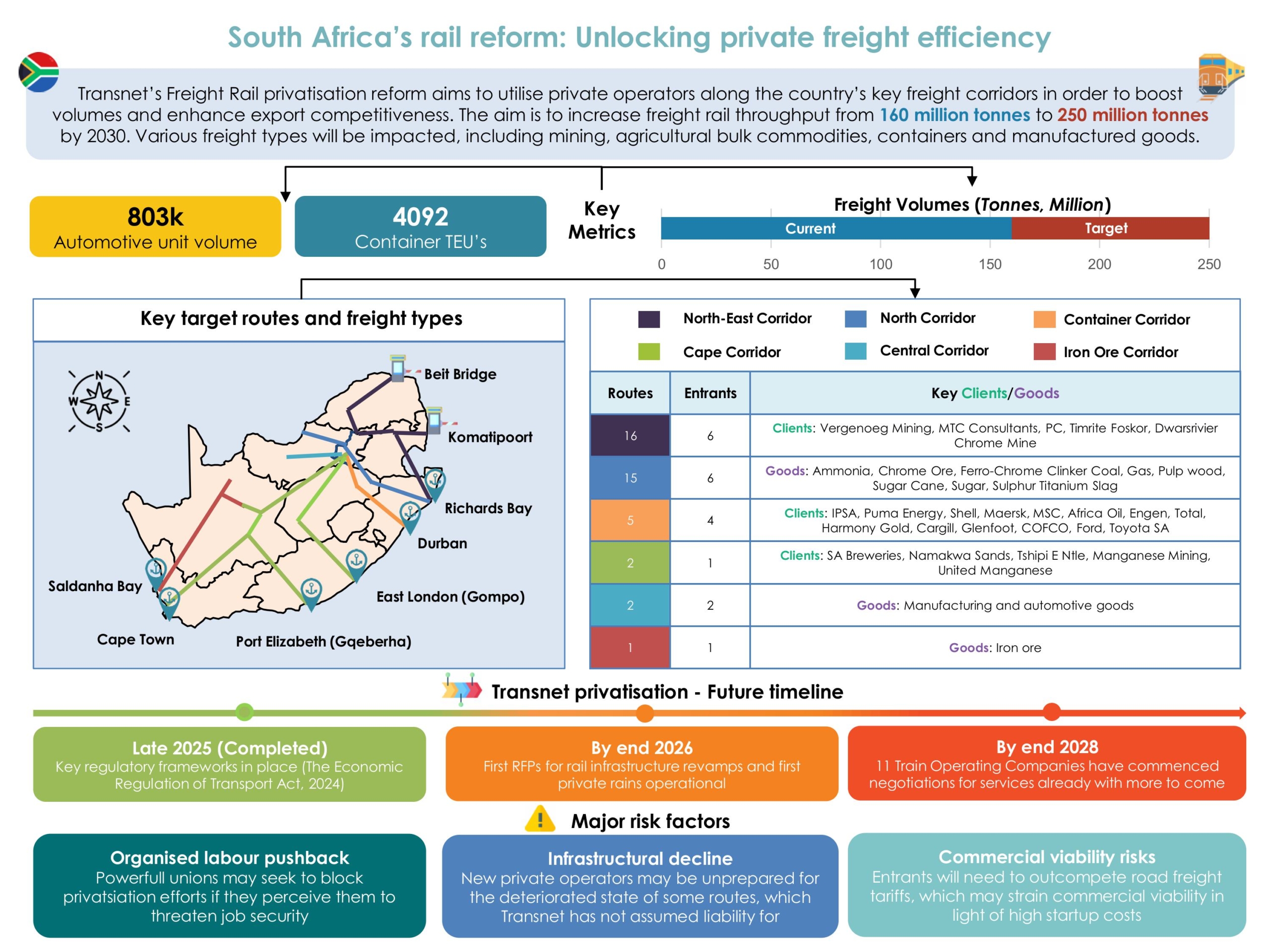
South Africa’s long-awaited freight rail reform gathered decisive momentum early in the quarter, marking the country’s most significant transport liberalisation in decades. The state-owned Transnet Freight Rail officially opened its network to private operators, a move designed to revive efficiency and restore confidence in the logistics sector after years of underperformance. The Road Freight Association hailed the reform as a turning point for the movement of goods, while Grindrod Freight Services became the first company to secure third-party access approval. The reform’s early impact was most visible in agriculture, as grain and citrus exporters prepared to capitalise on improved access to ports. In addition, government announcements confirmed that the first private trains would begin operations within the next 12-36 months, pending technical assessments of available rail slots. By inviting private capital and competition into a historically monopolised network, South Africa has positioned itself to rebuild industrial output and unlock long-term trade competitiveness.
During Q3 Africa became the arena for competing yet strategic overtures from Asia’s two largest economies. China expanded its zero-tariff access programme to encompass a broader range of African exports, reaffirming duty-free status for Ghana and opening pathways for Egypt, Kenya and Zimbabwe to deepen industrial and agri-trade integration. Several African states, including Kenya, advanced talks to convert dollar-denominated infrastructure loans into yuan, signalling a growing financial realignment. Parallel agreements on mining, digital technology and defence illustrated Beijing’s intent to consolidate its economic footprint across the continent. Meanwhile, Japan used the Ninth Tokyo International Conference on African Development (TICAD 9) to announce more than 300 cooperation agreements worth billions, spanning infrastructure, green energy and digital trade. A US$7 billion commitment towards the Nacala Corridor and parallel Samurai bond financing for Kenya underscored Tokyo’s pragmatic outreach. Together, these developments intensified Asia’s engagement in Africa, granting African governments greater leverage in a diversifying global order.
During the closing months of the quarter, the East African powerhouse inaugurated the Grand Ethiopian Renaissance Dam, marking the continent’s largest hydropower project and a decisive milestone in Africa’s energy transition. The dam’s activation promises to add over 5,000 MW to Ethiopia’s grid and positions the country as a future regional electricity exporter. Domestically, officials framed the project as the foundation for industrial growth, powering downstream sectors such as manufacturing, irrigation and green minerals processing. Yet the achievement reignited long-standing Nile Basin tensions. Egypt denounced Ethiopia’s unilateral reservoir management as a direct threat to its water security, while Sudan reported severe flooding and accused Addis Ababa of negligence. In response, Kenya’s President William Ruto offered to mediate and explore regional power trade to ease the standoff. For Ethiopia, GERD represents both triumph and test, an emblem of self-reliance that redefines energy diplomacy but also deepened the complex geopolitics of the Nile.
Throughout the third quarter of 2025, Gulf investment emerged as a defining force in Africa’s capital landscape, led by Qatar’s unprecedented US$103 billion commitment to the continent. The pledge signalled a structural deepening of economic engagement, moving beyond energy exports toward infrastructure and industrial diversification. Qatar’s Al Mansour Holdings signed a US$12 billion manufacturing and logistics deal with Botswana and a US$20 billion energy investment in Mozambique, while negotiations advanced on a US$7.5 billion partnership package with Egypt. Additional agreements included QatarEnergy’s purchase of a 27% stake in an Egyptian offshore block and new trade frameworks with Congo and Sierra Leone. Q3 also saw Saudi Arabia reinforce this Gulf momentum through Vision Invest’s entry into Africa via ARISE IIP and expanded industrial cooperation with Morocco. The initiatives mark a turning point in GCC–Africa relations, with the former transforming oil-linked diplomacy into long-term, multi-sector partnerships rooted in shared growth and strategic diversification.
As trade tensions and tariff barriers constrained Western markets in 2025, Africa emerged as the new frontier for Asia’s automotive expansion. During the third quarter, Chinese, Indian and Japanese manufacturers accelerated investments across the continent, capitalising on shifting supply chains and preferential access. South Africa became the focal point of this transformation as Chery, JMC, Tata Motors, Leapmotor and Isuzu announced new assembly ventures and product lines, while government negotiations advanced to widen local production. In North Africa, Morocco and Egypt attracted significant inflows from Chinese and South Korean suppliers such as Tianyouwei, Kuntai and Sailun, reinforcing their role as regional manufacturing hubs. Meanwhile, Isuzu East Africa confirmed plans to assemble its full vehicle range in Kenya, extending Asia’s industrial footprint. On the electric front, Toyota and Nissan prepared new EV models for South Africa, supported by Eskom’s fleet partnership with China’s BYD and Japan-backed charging investments in Kenya.
Toward the close of 2025, a wave of legislative and strategic reforms signalled Africa’s growing intent to govern its innovation economy through law and policy rather than pilot projects alone. Rwanda launched a US$200 million fintech investment strategy aimed at tightening regulatory coherence and boosting investor confidence. Namibia advanced a national digital roadmap and drafted a space bill to anchor its emerging technology sector, while Morocco’s “Digital Morocco 2030” strategy formalised its ambition to become a regional hub for data and innovation. Across East and West Africa, Kenya and Ghana introduced draft bills on data governance and innovation ecosystems, while in southern Africa Zambia enacted new ICT regulations with targeted grants to stimulate enterprise growth. In parallel, Burkina Faso and the broader ECOWAS bloc harmonised electronic communications frameworks to strengthen digital governance. Meanwhile, South Africa’s space agency unveiled a five-year expansion plan, underscoring how Africa’s regulatory architecture is steadily aligning with its technological aspirations.
As the final quarter of 2025 approached, Africa’s trade diplomacy entered a tense and uncertain phase with the expiry of the U.S. African Growth and Opportunity Act (AGOA) on 30 September. The lapse threatened immediate disruption to export sectors in textiles, agriculture and light manufacturing, particularly in Kenya, Ethiopia and South Africa. In response, African leaders launched coordinated appeals for renewal, with President Cyril Ramaphosa urging continued collaboration and Kenya lobbying Washington for a five-year extension through a bilateral deal. Mounting pressure prompted the Trump administration to signal support for a one-year reprieve, allowing negotiations to continue while safeguarding short-term market access. Yet even this proposed extension underscored the fragility of Africa’s reliance on unilateral trade preferences. Analysts and policymakers called for diversification, with renewed focus on intra-African commerce and alternative partnerships with China, the EU and Gulf states. The AGOA episode ultimately reaffirmed Africa’s urgency to secure more balanced and predictable trade frameworks.
Africa’s medical landscape evolved rapidly through the third quarter of 2025 as governments, universities and private investors accelerated efforts to build health sovereignty and research capacity. Kenya launched a US$250 million vaccine manufacturing facility alongside a digital health plan, positioning itself as the continent’s future vaccine hub. In West Africa, Nigeria partnered with Japan’s Ohara Pharmaceutical and China’s medical investors to localise drug production, including Africa’s first insulin plant. Morocco and the Africa CDC advanced a regional emergency response network, while Ghana and Guinea introduced new immunisation drives for HPV and malaria. In South Africa, medical innovation surged with the University of the Free State’s adoption of AI-assisted cancer therapy, the country’s first robotic kidney donor surgery, and Stellenbosch University’s cutting-edge training complex. Together the developments demonstrate a maturing biomedical ecosystem built on regional manufacturing, clinical research and AI-enabled precision care, signalling Africa’s steady shift from aid-dependent health models to innovation-driven autonomy.
As Africa’s digital economy expanded at record pace throughout 2025, governments and institutions intensified efforts to secure the continent’s cyberspace. During the third quarter, a series of new laws, frameworks and partnerships reflected a coordinated drive toward digital resilience. Somalia enacted its first cybercrime bill, while Nigeria and the East African Community advanced comprehensive cybersecurity and data protection strategies. Simultaneously, Nigeria partnered with Kaspersky on a cybersecurity pact, Morocco launched a Deloitte-backed CyberAcademy, and Rwanda’s partnership with Cisco and GIZ established a regional CyberHub for advanced training. Kenya strengthened institutional oversight through a new cybersecurity operations centre for banks and cooperation agreements with the Council of Europe and Romania. Private investment also grew, with AXIAN Group funding Nucleon Security to enhance African digital sovereignty. Across the continent, awareness campaigns in Lesotho, Ghana and Uganda broadened public participation. By October’s Cybersecurity Awareness Month, Africa had begun to translate fragmented initiatives into a continental security architecture anchoring its digital transformation.
As global trade patterns shifted under escalating tariff pressures and geopolitical uncertainty, Africa’s maritime landscape began to reorganise. Early in the quarter, shipping majors recalibrated routes to adapt to rising U.S. trade barriers and slowing transatlantic flows. Denmark’s Maersk discontinued its direct U.S.–South Africa cargo service and adjusted its Africa–South America network, reflecting declining demand for dollar-denominated exports. In response, Mediterranean Shipping Company expanded its direct South Africa–U.S. route, ensuring continuity for key exports. Meanwhile, North Africa emerged as a strategic winner as Morocco launched new shipping corridors to the UK and Northern Europe, boosting agricultural and automotive exports while reinforcing Casablanca and Tangier as regional logistics hubs. UK’s Samskip and UAE’s DP World followed suit, introducing additional sailings to capture rerouted trade flows. These developments revealed how African ports and carriers were adapting with agility, building new commercial arteries that linked the continent to diversified partners and shielding its export resilience from mounting global trade tensions.
Africa expands its gold footprint as record prices spur new activity
As global gold prices hit historic highs during Q3, African economies moved to consolidate their positions. Zimbabwe’s mining laboratories faced surging volumes while gold coins exceeded US$4,000 and stock market gains surpassed 45%. DRC began building national reserves, and Burkina Faso adopted a new mining code to increase state revenue from gold exports. Morocco announced a major discovery in the Guelmim region, while Egypt entered the digital gold market, signalling diversification from mines to mobile platforms.
South Africa navigates U.S. tariff shock amid renewed trade talks
In August, the U.S. imposed a 30% tariff on South African imports after trade negotiations stalled, threatening key manufacturing and agricultural exports. Pretoria swiftly introduced support measures to cushion affected industries while intensifying diplomatic engagement with Washington. By October, officials confirmed progress toward a compromise that could roll back some tariffs and pave the way for a new bilateral trade framework.
Botswana and Kenya turn to sovereign wealth funds to secure long-term growth
Botswana advanced an ambitious fiscal strategy during Q3 with the launch of a new sovereign wealth fund aimed at economic diversification. The initiative coincided with the government’s intention to acquire a controlling stake in De Beers, signalling a bid for greater value retention in the diamond sector. In parallel, Kenya unveiled plans to establish sovereign wealth and infrastructure funds to channel surplus revenues into long-term development projects.
World Bank lifts Africa’s growth outlook as inflation pressures ease
The World Bank upgraded Sub-Saharan Africa’s 2025 growth forecast to 3.8%, up from 3.5%, citing falling inflation, now below 4%, and stabilising exchange rates. Growth is projected to average 4.4% over the next two years as private consumption and investment recover in major economies such as Côte d’Ivoire, Ethiopia and Nigeria. Though positive the outlook remains constrained by debt burdens, youth unemployment, AGOA trade uncertainty and shifting U.S. economic policy.
How can we help you?
We have offices in four major cities in South Africa: Pretoria, Johannesburg, Cape Town, and Durban. Additionally, we have another 23 associate offices in the rest of Africa. Please contact your nearest office for any legal enquiry or assistance.

