


Constitutional Court Delivers Landmark but Incomplete Copyright Ruling. Parliament Must Now Seize the Opportunity to Modernise South Africa’s Copyright Law for the AI Era
JOHANNESBURG — On 26 June 2026, the Constitutional Court of South Africa handed down its long-awaited judgment in Ex Parte President of the Republic of South Africa: In re Constitutionality of the Copyright Amendment Bill and the Performers’ Protection Amendment Bill (CCT 306/24). The majority judgment, authored by Justice Mhlantla, marks the first time the Constitutional Court has undertaken an “abstract review” of the substance of a bill before its enactment into law — a historic and constitutionally significant exercise of the Court’s jurisdiction. Adams & Adams acted for the seventh amicus curiae in the matter.
The ruling provides important, if partial, clarity on a legislative process that has been underway for nearly a decade. It is a ruling that the creative industries and rights-holder community will need to study carefully — not only for what it decided, but for what it leaves unresolved – and for the important constraints it places on how the provisions it upheld may be applied in the future.
What the case was about
The case dealt with the constitutionality of the copyright exceptions to be introduced to the Copyright Act of 1978 by the Copyright Amendment Bill B13F of 2017.
Copyright exceptions specify cases where the copying, publication, and other uses of copyright works may be made without permission and therefore without remunerating the copyright owner.
The Bill had been passed by Parliament in 2024 and been sent to President Ramaphosa for signature. However, the President instead referred the copyright exceptions in the Bill to the Court in terms of the Constitution for his reservations that they could amount to an arbitrary deprivation of property that is unconstitutional in terms of the Constitution’s Bill of Rights.
What the Court decided
The Court declared that copyright is property that the Bill of Rights protects from arbitrary deprivation. It nevertheless upheld the constitutionality of the controversial policy shift from the system of “fair dealing” exceptions that are currently in the Act, to “fair use”, finding that, based on the terms of the President’s referral and the text of the “fair use” clause, it is not an arbitrary deprivation of property. The Court similarly upheld the constitutionality of a broad range of other new exceptions for personal use, translation, educational institutions, and for libraries, archives, museums and galleries, that will replace most of the exceptions that are in the current Act.
However, in the most significant ruling for rights holders, the Court held that sections 12D(1)–(5) are unconstitutional—the broad exceptions in favour of educational institutions that would have allowed the copying of textbooks. In finding that these provisions constituted an arbitrary deprivation of property, the majority of the Court found that those exceptions went further than necessary to achieve their stated public benefit purposes, failed to define key terms with sufficient precision, and placed the financial burden of funding public education on individual authors and rights holders rather than on the state. In a notable dissent, Justice Steven Majiedt argued that the majority placed insufficient weight on constitutional rights to education, equality and access to knowledge, and that he would have upheld those provisions.
Because sections 12D(1)–(5) were found unconstitutional, the President may not sign the Bill into law. Parliament must first cure the constitutional defect.
What the Judgment Does Not Resolve
Some of the interested parties and amici curiae in the case drew the Court’s attention to numerous other provisions that were not in the President’s referral that they argued were unconstitutional. These included the time limit of assignments of copyright that would result in an effective term of 25 years within which to exploit copyright works (undermining the legislated copyright term of the life of the author plus 50 years); the Minister’s power to prescribe essential terms of copyright contracts; a contract override provision that would apply indiscriminately to all copyright contracts and amount to serious limitations of the freedom to contract; onerous reporting requirements that discriminate against companies in their sanctions for non-compliance; and the possible removal of performers’ rights from persons who have had those rights until now.
The Court stated that its findings on the constitutionality of the upheld provisions are confined to the narrow facial context of the President’s reservations. They are not a permanent seal of constitutionality, and the ordinary avenues of constitutional challenge remain fully available once the Bill is enacted into law.
Significantly, the Court interpreted the exceptions that it upheld narrowly so that they could not be interpreted as allowing an unconditional deprivation of property. The reasoning the Court used to save the upheld provisions therefore simultaneously constrains their future scope. The interpretive rulings embedded in the majority judgment — that the inclusive wording “such as” before the list of permitted purposes in the “fair use” clause does not open the floodgates to any use of copyright works; that the substitution-effect factor in the “fair use” provision is a mandatory structural constraint; and that personal use is confined to the copying individual and forecloses redistribution even to friends — are therefore binding in the Court’s finding of the constitutionality of the exceptions.
The Elephant in the Room: Generative AI
The judgment delivers a ruling on legislation that, in an important sense, is already out of date. The Copyright Amendment Bill was drafted more than a decade ago. Neither the Bill nor the Court’s judgment contemplates generative artificial intelligence (AI) — now the single greatest challenge facing the creative industries globally.
The Court’s binding constraints on the “fair use” clause have one immediate and important consequence for the AI debate: they effectively foreclose the argument that the Bill’s exceptions can serve as a legal basis for AI machine learning and training data ingestion – in the sense of mass, systematic reproduction for commercial system development, that generate outputs that directly compete with, and substitute for, the source works – in South Africa. Such use does not qualify as personal use, does not share the attributes of the named educational and research purposes, and fails the mandatory substitution-effect test in the “fair use” clause.
The “fair use” clause, that had before the judgment been interpreted by many commentators as a give-away of copyright works to tech companies to train AI without restraint, has been robbed of such a permissive interpretation. However, this brings the development of AI in a manner that respects the rights of copyright back to nearly zero. Neither the Act nor the Bill has a text and data mining exception and there is no statutory safe harbour for AI training.
A Legislative Opportunity That Must Not Be Wasted
The constitutional defect means Parliament must revisit the Bill. The minimum response — excising sections 12D(1)–(5) and returning the revised Bill to the President — would be a missed opportunity of historic proportions.
The Bill was conceived in a pre-generative AI world. Parliament now has a rare and time-sensitive opportunity to do what was neglected throughout a decade of legislative process: commission a rigorous, independent socio-economic impact assessment that measures the actual consequences of the proposed exceptions and that asks the fundamental question of whether a framework designed in 2015 remains appropriate in 2026 and beyond.
The stated objective of the Bill has always been to equip South African copyright law for the challenges and opportunities of the digital age. The President’s signing into law a set of exceptions conceived over a decade ago — without addressing generative AI and without an economic impact assessment — would produce the precise opposite of that stated objective: a copyright framework that is simultaneously constitutionally fragile, economically unassessed, and technologically obsolete, before the ink is dry.
Parliament has been given a second chance. The creative industries of South Africa — and the constitutional rights of their creators — deserve more than a minimalist response to the Constitutional Court’s judgment on the Copyright Amendment Bill.
Chat Chat Chatterbot - Shall We Register Your Name?
So, you have birthed a chatbot and given it a name, what now? Should you register the name of the chatbot as a trade mark? The answer is a simple one, yes. If the chatbots are customer-facing, particu...
October 06 2026
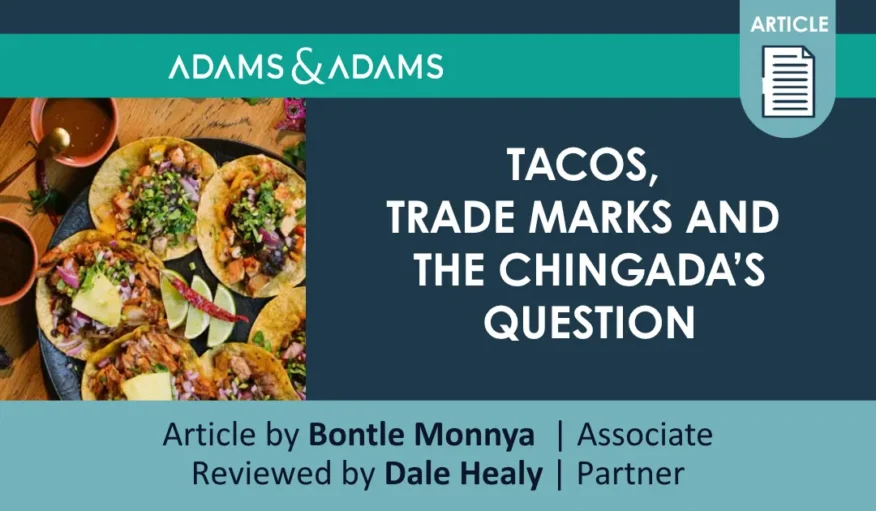
Tacos, trade marks and the CHINGADA’S question: The curious case of a Cape Town restaurant name
I went to Chingada’s in Cape Town this week for Taco Tuesday. It is a striking restaurant: colourful, theatrical and deliberately Mexican in its presentation. As tends to happen when one encounters ...
October 06 2026

Your Brand Crossed the Border. Did Your Trade Mark?
Why foreign brand owners should protect their trade marks in South Africa By Amina Suliman and Ntethelelo Ndaba Your Brand Is Here. Are Your Rights? Expanding into a new market is exciting. Businesses...
October 01 2026