


Tacos, trade marks and the CHINGADA’S question: The curious case of a Cape Town restaurant name
I went to Chingada’s in Cape Town this week for Taco Tuesday. It is a striking restaurant: colourful, theatrical and deliberately Mexican in its presentation. As tends to happen when one encounters an unfamiliar foreign word above a restaurant, I wondered what Chingadas actually means, which sent me down a rather more interesting rabbit hole.
Chingada and chingadas are related forms, and Mexican Spanish uses them in a range of vulgar expressions and contexts. The word is associated with the highly versatile Mexican verb chingar, which has a broad semantic range. Depending on context, chingar can convey meanings involving sexual activity, mistreatment, annoyance, failure, or simply vulgar emphasis. Chingada likewise appears in a variety of Mexican expressions, some sexual and some not. This is important in a trade mark case because dictionary translation is not the same thing as determining how a mark is understood in its linguistic and commercial context.
A Mexican Spanish speaker encountering CHINGADA’S is likely to appreciate connotations which may be completely invisible to an English-speaking South African consumer. Conversely, an English-speaking consumer may simply regard it as an exotic-sounding Spanish restaurant name, perhaps with no idea that the word carries vulgar connotations.
This is where my Taco Tuesday experience took an unexpected turn. Having wondered about the name, I conducted searches on the South African Trade Marks Registry and discovered a registration for CHINGADA’S in class 43, covering “Services for providing food and drink; temporary accommodation”. According to the Register, however, it was removed on 17 March 2026 following non-payment of the renewal fees. Nevertheless, this all raises an interesting question: Should CHINGADA’S ever have been registered in the first place?
Section 10(12) of the Trade Marks Act 194 of 1993 provides that a mark may not be registered, or if registered may be removed, where it is “inherently deceptive or the use of which would be likely to deceive or cause confusion, be contrary to law, be contra bonos mores (immoral), or be likely to give offence to any class of persons”. That wording makes CHINGADA’S an interesting candidate for scrutiny. It does not, however, mean that every swear word is automatically unregistrable.
Section 10(12) has a clear predecessor in the former Trade Marks Act 62 of 1963. Section 16(1) of that Act provided that it was not lawful to register matter whose use would be likely to deceive or cause confusion, or which would be “contrary to law or morality” or “likely to give offence or cause annoyance to any person or class of persons”. The provision is reproduced in Danco Clothing (Pty) Ltd v Nu-Care Marketing and Sales Promotions (Pty) Ltd and Another 1991 (4) SA 850 (AD), although the dispute in that case concerned deception or confusion rather than morality or offensiveness. The comparison is nevertheless useful as a matter of statutory history. While the language has changed, the legislature retained the principle that the content of a mark may render it unregistrable on grounds relating to morality or offensiveness.
There is also South African Breweries International (Finance) BV t/a SABMark International v Laugh It Off Promotions CC 2003 (2) All SA 454 (C), which is particularly interesting for present purposes. Although the case concerned infringement rather than an application to register an offensive mark, the High Court had occasion to consider section 10(12). In discussing the expression “likely to give offence”, the Court referred to the authors Webster & Page and the proposition that the provision contemplates marks which on their face offend by reason of their content. The litigation subsequently proceeded through the Supreme Court of Appeal and Constitutional Court, but those later proceedings principally concerned trade mark dilution and the constitutional implications of restraining parody and social commentary rather than registrability under section 10(12).
That is a useful proposition when considering a mark such as CHINGADA’S. The enquiry is not simply whether someone can construct a situation in which the mark causes offence, but whether the mark itself, by reason of its content, is such that the statutory threshold is met. Trade Mark Law does not require brands to be tasteful. There is no general statutory requirement that a trade mark be respectable, conventional or suitable for polite dinner conversation, so a mark may be provocative, irreverent or sexually suggestive without necessarily being contra bonos mores or likely to give offence to a class of persons within the meaning of section 10(12). Section 10(12) nevertheless draws a line and requires something more than simply identifying a vulgar dictionary meaning. The statutory language is not “a mark which contains a vulgar word” but a mark which is contra bonos mores or likely to give offence to any class of persons.
Suppose, for example, that CHINGADA’S were completely innocuous to the overwhelming majority of English-speaking South Africans, but readily understood as vulgar by a smaller class of persons in South Africa familiar with Mexican Spanish. Could that linguistic community constitute a “class of persons” for purposes of section 10(12)? And, if so, does the fact that most consumers would miss the offensive connotation matter?There is a respectable argument that it could, but the Registrar or Court would still have to determine whether the statutory likelihood of offence had been established and whether the mark, viewed in its proper commercial context, crossed the threshold contemplated by the provision. The existence of an offended class is therefore relevant, but it is not necessarily dispositive.
The trade mark enquiry should therefore not be reduced to the question “Is this a swear word?” but, “in the circumstances in which this mark is used, is it contra bonos mores or likely to give offence to a class of persons within the meaning of section 10(12)?” If the Registrar had known, during examination of the application, that the word CHINGADA’S carried vulgar Mexican connotations, the appropriate question would not simply have been whether the word was “offensive”. The linguistic meaning of the mark, the persons to whom that meaning would have been apparent, and the commercial context in which the mark was to be used would all potentially have been relevant to that enquiry.A further point worth noting from the Register itself is that the expired registration contains no endorsement recording the meaning or derivation of CHINGADA’S. The official action is unfortunately inaccessible on the Registry’s portal, so it is impossible from the publicly available record to establish whether the Registrar ever called upon the applicant to endorse the mark as to its meaning and derivation.
The absence of an endorsement should not be treated as evidence that the issue was never considered. It does, however, mean that there is nothing in the presently accessible record indicating whether the potential significance of the mark’s Mexican Spanish meaning was raised during examination. If the Registrar did call for its meaning and derivation and nevertheless accepted the mark, the position becomes particularly interesting as it might suggest that, with the meaning before the Registry, the Registrar did not regard CHINGADA’S as contra bonos mores or likely to give offence to a class of persons within section 10(12).
So where does that leave CHINGADA’S? The answer is not straightforward. The combination of its potentially vulgar meanings and connotations in Mexican Spanish and the statutory prohibition against marks which are contra bonos mores or likely to give offence to a class of persons provides a legitimate basis for questioning whether the mark should have proceeded to registration. I would not, however, go so far as to say that registration was plainly impermissible.
Whatever the answer to the section 10(12) question, given that the registration was removed from the register earlier this year, it did not ultimately meet its demise through a judicial determination that CHINGADA’S was too offensive for the South African Register. That is a much less philosophically satisfying ending.
Nonetheless, the expiry of the registration does not necessarily mean that the proprietor has no rights in the name. Trade mark registration is not the only source of protection for a commercial brand and, depending on the facts, goodwill and reputation may support a passing-off action, while other intellectual property or commercial rights may also be relevant. Of course, the restaurant continues to trade under the name.
In conclusion, the story of CHINGADA’S illustrates that registration is not a certificate of good taste. A foreign expression that appears entirely innocuous, or merely exotic, to the majority of consumers may carry distinctly vulgar or offensive connotations for a linguistic minority.
CHINGADA’S therefore makes for a surprisingly good trade mark law problem because it forces us to ask whose understanding of a trade mark matters, and when linguistic offensiveness becomes legal unregistrability. It is, perhaps, an unexpectedly complicated question to emerge from a Taco Tuesday dinner.
Chat Chat Chatterbot - Shall We Register Your Name?
So, you have birthed a chatbot and given it a name, what now? Should you register the name of the chatbot as a trade mark? The answer is a simple one, yes. If the chatbots are customer-facing, particu...
October 06 2026
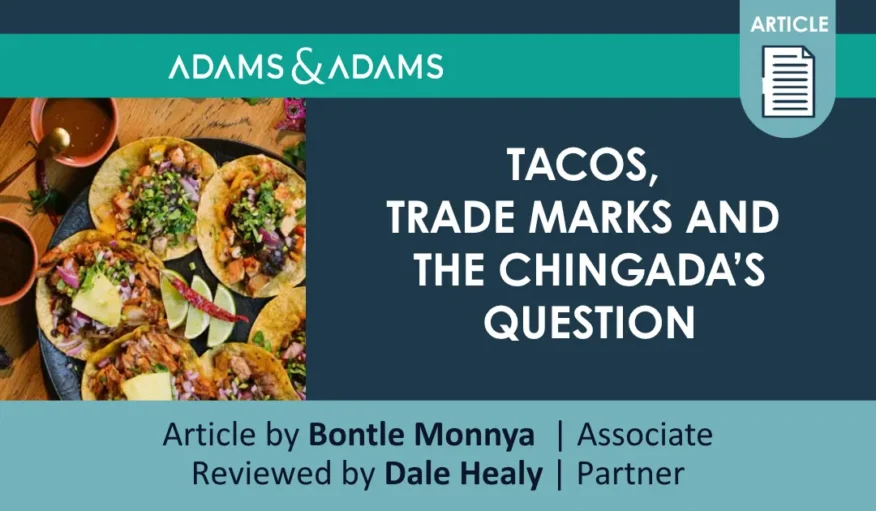
Tacos, trade marks and the CHINGADA’S question: The curious case of a Cape Town restaurant name
I went to Chingada’s in Cape Town this week for Taco Tuesday. It is a striking restaurant: colourful, theatrical and deliberately Mexican in its presentation. As tends to happen when one encounters ...
October 06 2026
Your Brand Crossed the Border. Did Your Trade Mark?
Why foreign brand owners should protect their trade marks in South Africa By Amina Suliman and Ntethelelo Ndaba Your Brand Is Here. Are Your Rights? Expanding into a new market is exciting. Businesses...
October 01 2026