


Year-End Functions and the Question of Liability: What Employers and Insurers Should Consider
As the festive season approaches and offices across South Africa gear up for year-end celebrations, employers would do well to pause before popping the champagne. Behind the glitter and goodwill of the office party lies a web of potential liability — and, too often, a dangerous gap in insurance coverage.
Year-end functions are a staple of corporate culture. They are an opportunity to reward staff, foster team spirit, and close the year on a high note. But when things go wrong — and they do, every year — the consequences can be devastating, both for the individuals involved and for the businesses that hosted the event.
The risks are real
The unfortunate reality is that year-end functions are breeding grounds for a range of incidents. Alcohol-fuelled misconduct, slip-and-fall injuries, motor vehicle accidents after the party, allegations of sexual harassment, and even fatalities — these are not hypothetical scenarios. They play out in workplaces and at off-site venues across the country each December.
Under the Occupational Health and Safety Act 85 of 1993, employers have a general duty to provide and maintain a working environment that is safe and without risk to the health of employees. South African courts have confirmed that this duty can extend beyond the physical workplace to employer-sponsored events, particularly where attendance is expected or encouraged.
The Compensation for Occupational Injuries and Diseases Act 130 of 1993 (COIDA) may also come into play. Where an employee suffers an injury “in the course of employment,” a claim under COIDA could arise — and the boundaries of what constitutes the “course of employment” at a company function are not always clear-cut.
Beyond statute, the common-law principles of vicarious liability mean that an employer may be held liable for the wrongful acts of its employees committed within the course and scope of their employment — a concept that can extend to conduct at a work function.
The insurance gap
Despite these well-documented risks, many employers enter the festive season without adequate insurance cover. Public liability insurance, employers’ liability insurance, and commercial general liability policies are critical — yet their terms, exclusions, and limits are seldom reviewed with year-end functions in mind.
Key questions every employer should be asking include:
- Does my public liability policy cover off-site events, or is it limited to my business premises?
- Are alcohol-related incidents excluded under my policy wording?
- Does my employers’ liability cover extend to social functions organised or sanctioned by the company?
- Is there adequate cover for third-party claims arising from employee conduct at a year-end event?
- If I hire a venue, does the venue’s insurance cover my employees and guests, or does the risk sit with me?
Too often, these questions are asked only after an incident — by which time the answer may be an unwelcome one.
A call to the insurance industry
For insurers and brokers, the festive season represents both a risk and an opportunity. The insurance industry is well placed to take a proactive role by offering tailored event liability products, educating employers on the scope and limitations of existing cover, and encouraging pre-event risk assessments.
Short-term insurers should consider developing specific endorsements or standalone policies for corporate functions that address alcohol liability, transportation arrangements, and venue-related risks. Brokers, in turn, should be initiating conversations with their commercial clients well before November — not in January, when the claims start rolling in.
What employers can do now
Preparation is the best policy — in every sense. Employers across all industries should take the following steps ahead of the festive season:
2.1 Review existing insurance cover. Engage your broker to confirm that your public liability and employers’ liability policies adequately cover year-end events, including off-site venues and alcohol-related risks.
2.2 Conduct a risk assessment. Identify potential hazards at the planned venue and put practical measures in place — limit alcohol availability, arrange safe transportation, and appoint sober supervisors.
2.3 Set clear expectations. Communicate a code of conduct to employees in advance. Make it clear that workplace policies, including those on harassment and misconduct, apply at the function.
2.4 Document everything. Keep records of the measures taken, communications issued, and any incidents that occur. This can be critical in defending a claim.
2.5 Consider event-specific cover. Where existing policies fall short, explore standalone event liability insurance.
The bottom line
Year-end functions should be a celebration, not a liability event. But without proper planning and appropriate insurance, employers expose themselves — and their employees — to significant risk. The insurance industry has a vital role to play in closing this gap, and employers have a responsibility to ensure they are not caught off guard.
As the saying goes, it is better to have insurance and not need it than to need it and not have it.
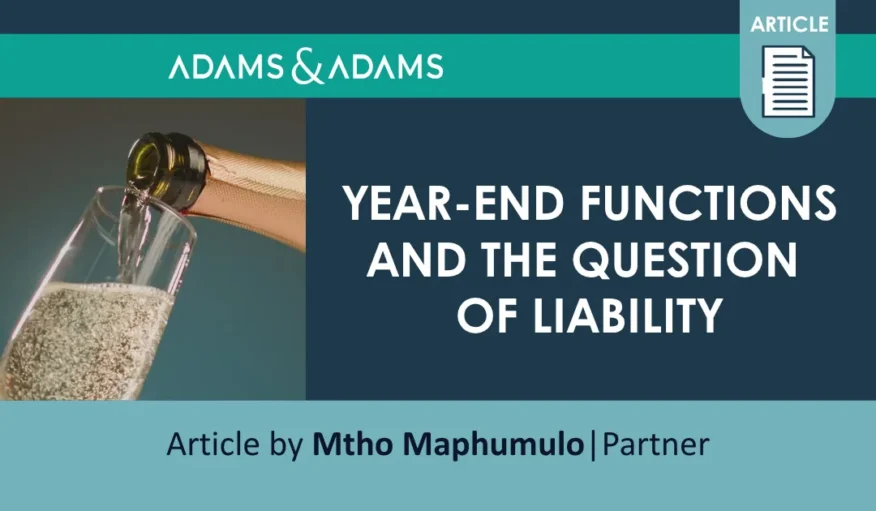
Year-End Functions and the Question of Liability: What Employers and Insurers Should Consider
As the festive season approaches and offices across South Africa gear up for year-end celebrations, employers would do well to pause before popping the champagne. Behind the glitter and goodwill of th...
October 07 2026
Frozen Accounts and Fraudulent Funds: Navigating the Rights of Banks, Customers and SARS
A recent judgment of the High Court has affirmed the right of a bank to freeze a customer’s account without prior notice where it reasonably suspects that the account has received the proceeds o...
September 30 2026

Ten Judgments, One Playbook: What Insurers Need to Know About US Coverage Trends
Over the past few months, Jean-Paul Rudd, Partner at Adams & Adams, has unpacked ten US judgments shaping how courts read policy wording, apply exclusions and define the limits of indemnity. From ...
September 28 2026